
AI engines read and cite you
What's on from day one#
Nothing to switch on: every page on a docsbook.io address gets all of this, on every plan.
llms.txtandllms-full.txt— every page with its Markdown address, plus the languages the site is published in- A Markdown copy of every page — the page as plain text, a fraction of the weight of its HTML
- Text in the HTML — pages are server-rendered, so a crawler that runs no JavaScript still reads every word
- AI crawlers welcome — the crawlers of OpenAI, Anthropic, Perplexity, Google and Apple may read every page
- An answer-first summary — the first paragraph becomes a summary block under the title, up to 280 characters, marked
speakablein JSON-LD; frontmattertldr:replaces it - Dates and authors — a visible Updated date from the last commit, plus
datePublished,dateModifiedand aPersonauthor in JSON-LD - Buttons that hand a page to AI — Copy page as Markdown, Open in ChatGPT and Open in Claude, plus an MCP button in the chat header that installs your docs in a reader's agent
- An MCP server for your readers' agents — each page names it in a
mcp-servermeta tag; see MCP server
No crawler is refused by default. High-volume crawlers such as Bytespider, PetalBot, Amazonbot and Meta-ExternalAgent read your site like any other; what they read counts toward your plan's crawl allowance instead.
To close your site to AI engines, switch off Readable and quotable by AI engines on Settings ▸ Access ▸ AI engines: the project leaves llms.txt and llms-full.txt, and the named AI crawlers are refused in robots.txt. Search engines are unaffected.
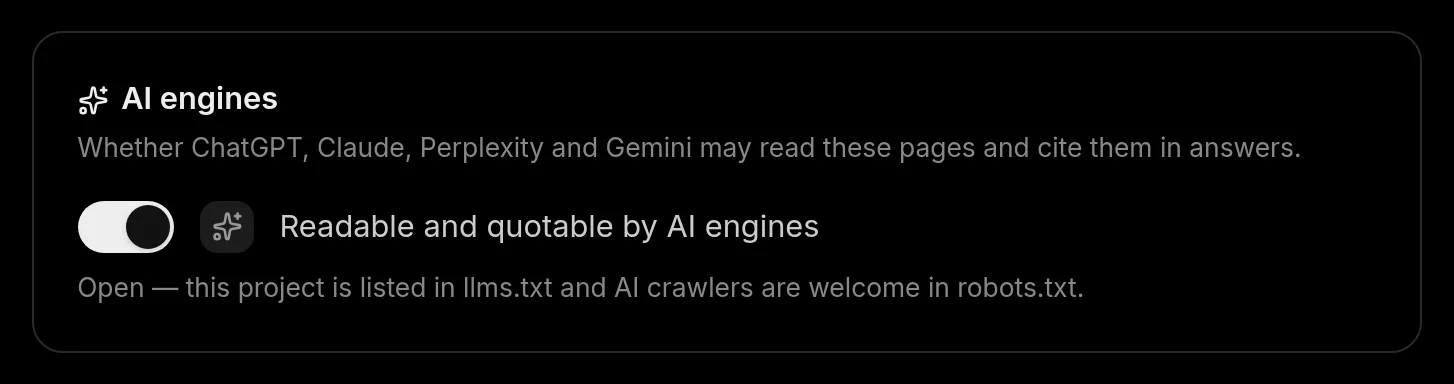
On a custom domain, llms.txt, the summary block, the Updated date and most of the JSON-LD currently appear on docsbook.io addresses only. The Markdown copy of each page works on every address.
What the agent does on its own#
On Pro, the agent works toward the goal every project has: be found on Google and in AI answers. For AI answers it runs two weekly triggers and a citability check, judged against the GEO axes of the expertise catalog: Eligibility, AI crawlers, llms.txt, Passages, Content moves and Measurement.
Do AI engines cite you, weekly
- Watches — Google's AI Overview for the questions a buyer asks, with the sources it cites, and Bing's results, which Copilot draws on
- Changes — the pages behind wrong answers: an outdated claim repeated, a feature said not to exist, a competitor named instead
- Measures — how many watched questions come back naming the page, read again on the check date
- Axes — Measurement, Passages
Where competitors get named, weekly
- Watches — who results pages and AI answers name for the questions this product should own
- Changes — reads up to 50 pages of a rival's docs, records which catalog rules their winning pages follow, and writes the page you are missing
- Measures — which questions name a competitor instead of you
- Axes — Content moves, Passages
citability check
- Watches —
robots.txtagainst 7 named AI agents, each page fetched both as a browser and asOAI-SearchBot, and at least 200 words readable without JavaScript - Changes — whatever blocks a fetch or leaves a page with nothing to quote
- Measures — five scores out of 100, computed from the fetches rather than written by a model
- Axes — Eligibility, AI crawlers, llms.txt
Answer engines score passages, not whole pages, so the agent holds each section to these catalog rules:
- One question per section — the section answers it fully on its own
- A named subject — the section says what it is about instead of "it" or "this"
- Numbers in place — every claim's supporting number sits in the same paragraph as the claim
- No keyword stuffing — the catalog records that repeating a phrase performs worse than leaving the page alone
A GEO change states its bet like any other: the watched questions it expects to name the page, today's count, the predicted one and a check date. Docsbook computes the verdict from the before and after readings.
See it working#
Analytics ▸ GEO is one list with a View switch. The AI visibility page explains each reading and its limits.
| View | What it shows |
|---|---|
| Pages | Which pages AI crawlers read, split into AI Answers, Indexing and Training, and how many checked questions cite each |
| Crawlers | Each AI crawler by company, with requests, distinct visitors and how often its engine names you |
| Prompt mentions | The questions checked against answer engines, and which ones named you |
| Prompt demand | The search demand behind a question your buyers ask |
| Competitors, Competitor prompts | Who the engines name for your questions, and where they name them instead of you |
| Competitor tactics | Which catalog rules the pages engines cite apply |
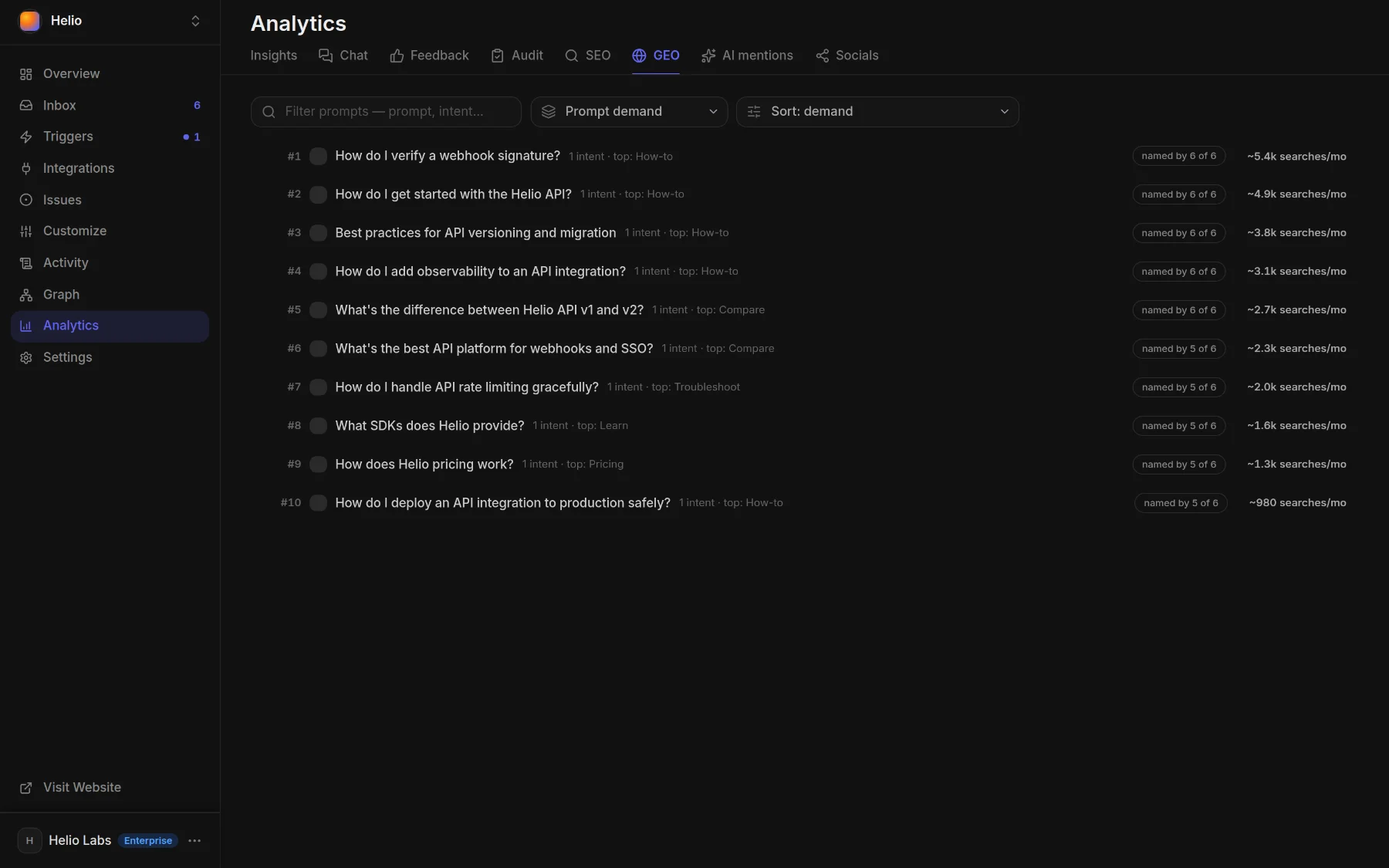
Analytics ▸ Audit shows where your pages stand against the two GEO topics: What answer engines require, and Being quoted by models.
Tell your agent#
Say it in a sentence, from Claude Code, Cursor, Codex or the panel chat:
What does Google's AI Overview say about our product? Fix what it gets wrong.
Which questions name a competitor instead of us? Write the pages we're missing.
Can AI crawlers read our docs? Check and fix whatever blocks them.
Watch these questions every day: "best API docs tool", "host docs from GitHub".
Run the weekly check of what AI engines say about us.FAQ#
Does llms.txt get my docs cited?
There is no evidence that it does. Google says its AI features need no AI text file, and none of OpenAI's, Anthropic's or Perplexity's crawler documentation says they read a site's llms.txt. Docsbook generates it because it costs you nothing and gives an agent you point at it a map of your docs.
Which AI crawlers can read my docs?
All of them by default. Switching off AI engines refuses the AI crawlers by name.
Can I stay in Google but out of AI answers?
Partly. Switching off AI engines refuses the named AI crawlers and drops the project from llms.txt, but Google's AI Overviews are built from Google's search index, so a page listed in Google can still be quoted there. robots.txt is also a request, not a lock: anything already quoted stays quoted until it is crawled again.
Do I need a special writing style for AI engines?
No. Google says its AI features need no special writing style or markup, only a page that is indexed and allowed a snippet. What helps is sections that answer one question on their own.